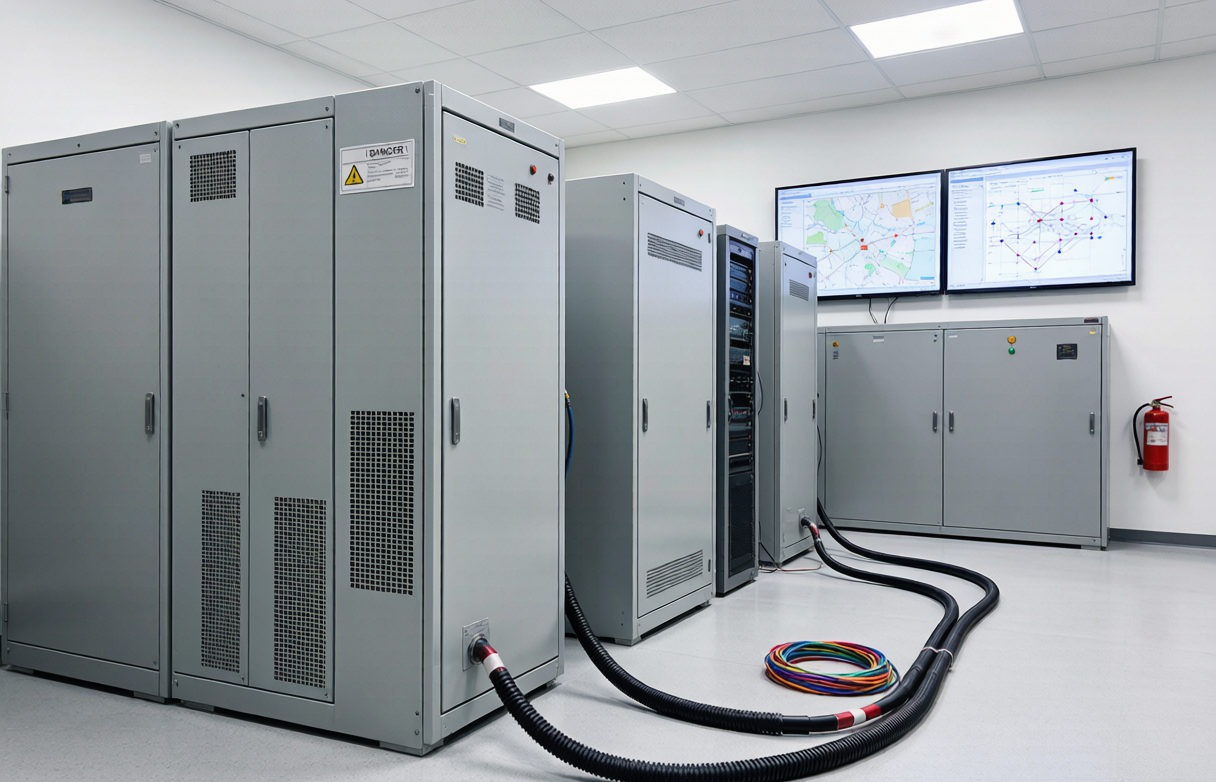
Power grid dispatch centers need to aggregate operational data from substations and renewable energy stations in real time, performing AI load forecasting and fault warnings. This imposes stringent requirements on the reliability, wide-temperature range, and read/write performance of underlying embedded storage chips. As an industrial-grade storage and AI computing service provider, Stonbel offers complete eMMC/UFS embedded storage solutions for government and enterprise clients. This article analyzes the cost structure, key pricing factors, and real project cases to help readers select cost-effective storage solutions for power dispatching scenarios.
Manufacturing & R&D: Adaptation from Chip to System
Q: In energy power dispatching scenarios, why are eMMC and UFS embedded storage so critical? How does Stonbel ensure product adaptability in manufacturing and R&D?
A: Edge nodes, data collectors, and AI inference devices in power grid dispatching centers mostly use embedded main control chips that require directly soldered eMMC or UFS storage chips, eliminating traditional slots to cope with vibration, temperature differences, and space constraints. Our eMMC_UFS embedded storage for energy power dispatching covers eMMC 5.1 and UFS 2.1/3.1 standards, with capacities ranging from 8GB to 256GB. eMMC 5.1 delivers sequential read/write speeds up to 320/260 MB/s, meeting routine data collection and status reporting needs, while UFS 2.1/3.1 offers far higher serial bandwidth, with sequential read speeds up to 4300 MB/s, suitable for high-performance AI inference nodes and edge servers. In manufacturing, we strictly follow JESD84 and JESD220 specifications. All chips undergo industrial wide-temperature testing: eMMC

Market & Service: Cost and Quotation Factors
Q: What is the approximate cost of deploying an eMMC_UFS embedded storage solution for energy power dispatching? What factors affect the quotation?
A: Cost is not fixed and depends on three dimensions. First, storage capacity and type: eMMC is lower-cost and suits mid-to-low-end controllers like dispatching terminals and data collectors; UFS offers higher performance at a higher price, used in edge inference servers or AI boxes. Second, operating temperature grade: industrial wide-temperature (-40 to 85°C or -40 to 105°C) chips undergo rigorous screening with lower yield, costing about 30%-50% more than commercial-grade. Third, supporting services: we provide factory-direct after-sales support and value-added services such as hardware selection and compatibility testing, helping customers shorten pre-project preparation time by over 30% and reduce equipment failure rates in 7×24-hour operation scenarios. In one provincial power dispatching project, we deployed
Industry Outlook: From Single-Point Storage to Cloud-Edge Collaboration
Q: How will demand for embedded storage in energy power dispatching evolve? What is Stonbel's strategy?
A: As AI load forecasting and fault warning models grow in complexity, dispatching centers will see rapid growth in storage bandwidth and capacity requirements. UFS 3.1's serial bandwidth advantage will become increasingly prominent, especially in scenarios requiring real-time processing of massive video streams and sensor data. We forecast that the market for eMMC_UFS embedded storage in energy power dispatching will double within five years, with UFS share gradually increasing. Stonbel will continue investing in R&D, deeply adapting with domestic main control chip vendors to ensure compliance with Xinchuang requirements, and compatibility with domestic CPUs such as Kunpeng, Phytium, and Hygon, as well as Kylin/UOS operating systems and AI chips. We will also further improve our cloud-edge collaborative unified management platform, enabling automated policy distribution and firmware upgrades between headquarters and branch offices to reduce distributed
Q1: How should eMMC and UFS be selected for energy power dispatching scenarios?
A: The choice depends on performance and cost requirements. eMMC 5.1 offers sequential read/write speeds of 320/260 MB/s, operates from -40 to 85°C, has lower cost and mature ecosystem, making it suitable for mid-to-low-end controllers like dispatching terminals and data collectors. UFS 2.1/3.1 delivers sequential read speeds up to 4300 MB/s, operates from -40 to 105°C, and offers far higher bandwidth than eMMC, ideal for high-performance AI inference nodes and edge servers. If the device needs real-time processing of large data volumes, such as video stream analysis or high-frequency sensor data, UFS is recommended; if cost-sensitive with moderate performance requirements, eMMC is more suitable. In the same project, a hybrid deployment based on node roles can balance overall budget.
Q2: What are the key factors affecting the quotation for eMMC_UFS embedded storage in energy power dispatching?
A: Key factors include: storage type (eMMC or UFS), capacity (8GB to 256GB), operating temperature grade (commercial or industrial wide-temperature -40 to 85°C/105°C), and supporting services (such as compatibility testing and factory-direct after-sales). Industrial wide-temperature chips undergo stringent screening with lower yield, costing 30%-50% more than commercial-grade. Additionally, order volume, delivery lead time, and service scope affect unit pricing. Stonbel offers factory-direct channels to reduce intermediate steps, and through intelligent data tiering and cold/hot archiving, overall storage costs can be reduced by over 30%. Specific quotations require evaluation based on actual project needs; we recommend customers provide detailed technical specifications and operating environment descriptions.
Q3: How does Stonbel's eMMC_UFS embedded storage solution for energy power dispatching ensure reliability?
A: Our eMMC and UFS chips comply with JESD84 and JESD220 standards, with operating temperatures from -40 to 85°C (UFS up to -40 to 105°C), ensuring stable operation in harsh environments such as outdoor substations and renewable energy stations. We also provide factory-direct after-sales support and assist customers with hardware selection and compatibility testing, shortening pre-project preparation time by over 30% and reducing equipment failure rates in 7×24-hour operation scenarios. Furthermore, the solution supports multi-replica and erasure coding for disaster recovery, ensuring no data loss or business interruption during single-disk failures, node failures, or even rack-level failures, meeting high-availability requirements in the power industry. Through intelligent O&M and fault prediction using multi-dimensional metrics such as SMART, IO latency, and temperature for real-time monitoring, potential failures are predicted in advance with automatic data migration, reducing unplanned downtime by over 80%.
The cost of eMMC/UFS embedded storage for power dispatching is not fixed but determined by storage type, capacity, temperature grade, and supporting services. Stonbel offers a full range of eMMC 5.1 and UFS 2.1/3.1 products, along with industrial wide-temperature support, direct factory warranty, and cloud-edge unified management, helping customers control costs while ensuring 7×24 reliable operation. Real projects show that proper selection and services effectively reduce failure rates and improve real-time data processing. As AI deepens in power dispatching, UFS adoption will grow, and Stonbel will continue optimizing solutions for safe and efficient dispatch operations.