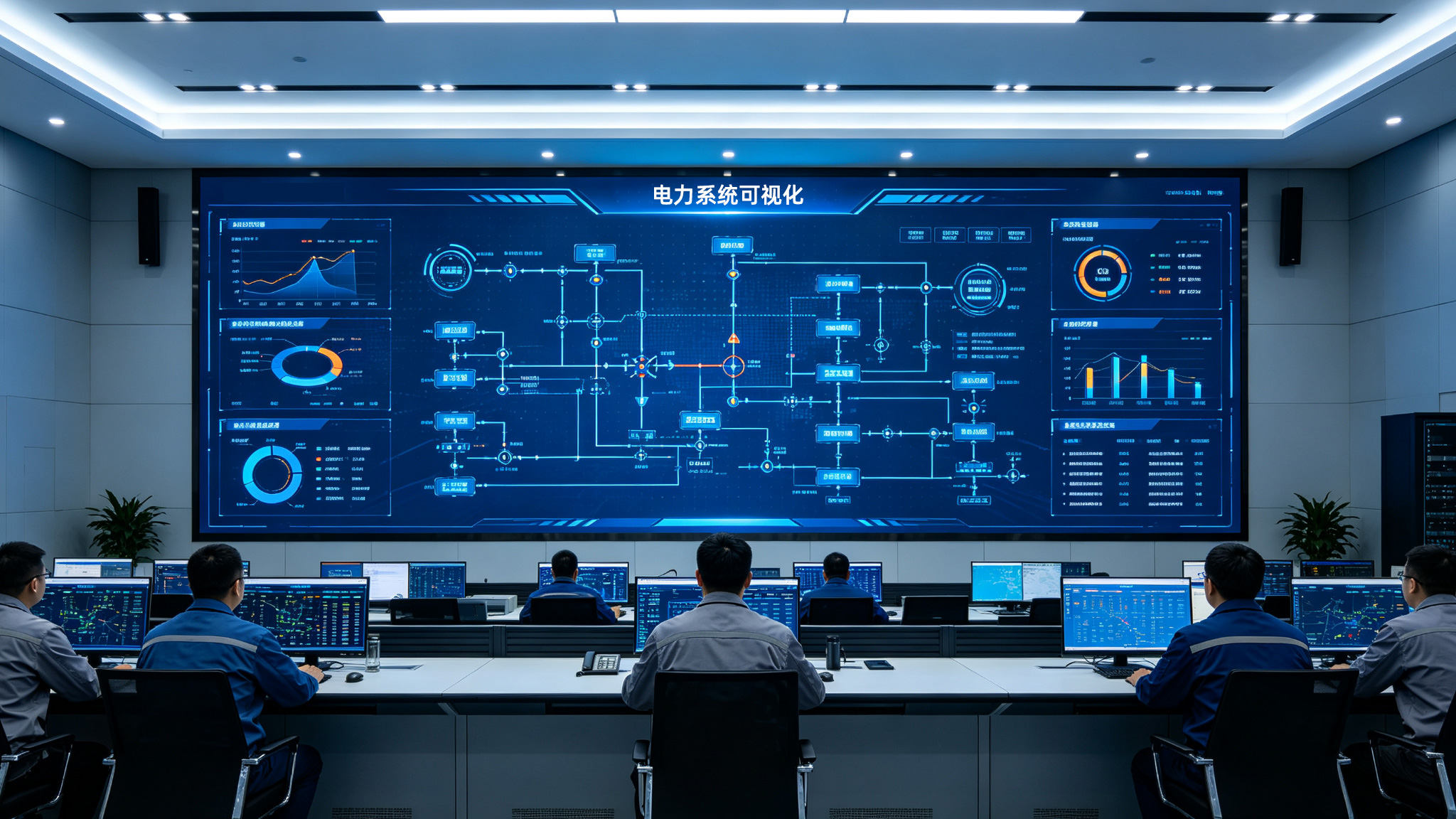
Energy centers, as operational hubs for power, petroleum, and chemical industries, impose stringent requirements on display stability, clarity, and protection in their command dispatch halls and monitoring centers. COB fine-pitch displays, with their high reliability, extended lifespan, and excellent image quality, are becoming the mainstream choice for such scenarios. However, with numerous brands and models on the market, scientific selection to avoid pitfalls is a critical skill for weak-current integrators and engineering contractors. Based on practical project experience, this article presents a full-process selection checklist—from requirement analysis to acceptance and maintenance—to help you make efficient decisions and ensure successful project delivery.
Process Overview
Selecting a COB fine-pitch display for an energy center is not a simple spec comparison, but a systematic project involving requirement analysis, solution design, product validation, installation, and long-term maintenance. A complete selection process typically includes seven key steps: defining application scenarios and
Step-by-Step Checklist
Step 1: Define application scenarios and requirements. Display needs in energy centers vary, from real-time data monitoring in dispatch centers, multi-signal coordination in emergency command, to detailed chart display in training rooms. Document the content types (e.g., SCADA interfaces, video surveillance feeds, GIS maps), viewing distances, ambient lighting (direct sunlight or high-brightness lighting), and whether
Step-by-Step Checklist
Step 2: Determine core technical parameters. For energy centers, pixel pitch is the primary parameter, determining physical resolution. Shorter viewing distances require smaller pitches (e.g., P0.7-P1.2) for a grain-free image. Refresh rate should be no less than 3840Hz to ensure flicker-free and tear-free display of
Step-by-Step Checklist
Step 3: Evaluate protection and stability. Energy centers often have dust, oil, temperature and humidity fluctuations. The COB display's protection rating should reach IP55 or higher for effective dust and water splash resistance, reducing environment-related failures. Also assess anti-static capability, PCB coating (e.g., conformal
Step-by-Step Checklist
Step 4: Review manufacturer qualifications and service capabilities. Prioritize manufacturers with 3C, CE, FCC, ISO9001, ISO14001, ROHS certifications, and military or classified qualifications if sensitive projects are involved. These certifications ensure compliance and reliability. Verify if the manufacturer is the original source, providing end-to-end technical support including bid assistance, solution design,
Step-by-Step Checklist
Step 5: Establish budget and cost model. Focus not only on purchase price but on total cost of ownership (TCO), including energy consumption (saving over 30%), maintenance costs (over 70% lower than traditional equipment), and business losses from downtime. Direct factory supply eliminates intermediaries, offering better margins and avoiding multi-vendor coordination costs. Within
Step-by-Step Checklist
Step 6: Implement installation and commissioning. Conduct on-site surveys before installation to confirm load-bearing walls, power supply, and signal cabling routes. Ensure panel flatness and seam gaps meet specifications, especially for COB modules. During commissioning, perform color calibration, white balance adjustment, and signal source testing to ensure seamless multi-signal control (simultaneously integrating
Step-by-Step Checklist
Step 7: Establish acceptance and maintenance standards. Acceptance should verify contract parameters item by item, including resolution, brightness uniformity, color accuracy (ΔE value), and dead pixel rate. Reference authoritative test reports or industry standards. After acceptance, confirm warranty terms, response time, and spare parts supply cycle. For energy centers, integrate
Acceptance Criteria
Acceptance is critical to ensure the COB display meets requirements. First, check for color differences, brightness inconsistency between modules, or dead pixels (typically within 1/10,000) on solid color screens (red, green, blue, white). Second, use test patterns to verify smooth gray scale transitions without banding or steps. Third, play fast-moving content to confirm 3840Hz refresh rate without flicker. Finally, simulate typical energy center
Precautions
Beware of low-price traps. Products priced below market average often compromise on LED quality, driver ICs, and power modules, leading to rapid brightness decay and high failure rates. Always request detailed specifications and third-party test reports. Distinguish COB from SMD technology; COB, with chip-level packaging, offers superior impact, dust, and heat resistance,
Q1: How to choose the pixel pitch for an energy center COB fine-pitch display?
A: Pixel pitch depends on viewing distance. For energy center dispatch halls with typical viewing distances of 3-5 meters, P1.2-P1.5 is recommended. For closer distances (2-3 meters), P0.9-P1.0 is needed to avoid a grainy appearance. Consider content detail; for small text or complex charts, smaller pitches (P0.7-P1.2) provide sharper clarity. Simulate based on actual installation position and primary viewing distance.
Q2: What protection rating is required for displays in energy center environments?
A: Energy centers may have dust, oil, temperature and humidity fluctuations, and occasional moisture. The display should have a protection rating of at least IP55, providing dust-tight and water spray resistance. For harsher environments (e.g., semi-outdoor areas), IP65 or higher is recommended. Higher protection significantly reduces environment-related failures, extends equipment life, and minimizes unplanned maintenance costs.
Q3: How to evaluate the long-term reliability of an energy center COB display?
A: Evaluate three aspects: core components such as COB LED packaging process and driver IC brand; thermal design, as good heat dissipation slows light decay and maintains brightness; and the manufacturer's warranty and service network. Choose products with a lifespan design of over 100,000 hours, military-grade stability for 7×24 operation, and nationwide localized service to ensure long-term performance.
Q4: Are maintenance costs high for energy center COB displays?
A: COB displays have lower maintenance costs than traditional SMD displays. The fully sealed structure reduces dust and static-related failures, and modules support front access for quick replacement. Intelligent fault detection and remote maintenance enable early warnings, reducing response time to under 30 minutes and cross-regional maintenance costs
Selecting a COB fine-pitch display for an energy center is a systematic process that requires comprehensive consideration of scenario needs, technical parameters, protection capabilities, manufacturer support, cost control, and installation acceptance. By following the seven-step checklist above, integrators and contractors can effectively avoid common pitfalls and choose a display solution that meets performance requirements while offering high cost-effectiveness. Remember, partnering with a manufacturer that provides direct supply, full-process technical support, and nationwide localized service is key to ensuring long-term stable operation. Ultimately, a reliable COB fine-pitch display not only enhances operational efficiency but also serves as a solid foundation for safe production and emergency command.