Power grid dispatch centers are moving from passive response to proactive prediction, needing real-time data aggregation and unified storage across provincial substations and renewable stations to support AI load forecasting and fault alerts. Embedded storage chips handling data persistence and high-speed I/O are key to system stability. Stonbel, as a source manufacturer of LED/LCD commercial displays and storage infrastructure, offers industrial wide-temperature eMMC_UFS modules and integrated dispatch screen solutions, closing the loop from data ingestion, storage, analysis, to visualization. This article reviews the real value of source manufacturers in qualifications, capacity, service, and case studies.
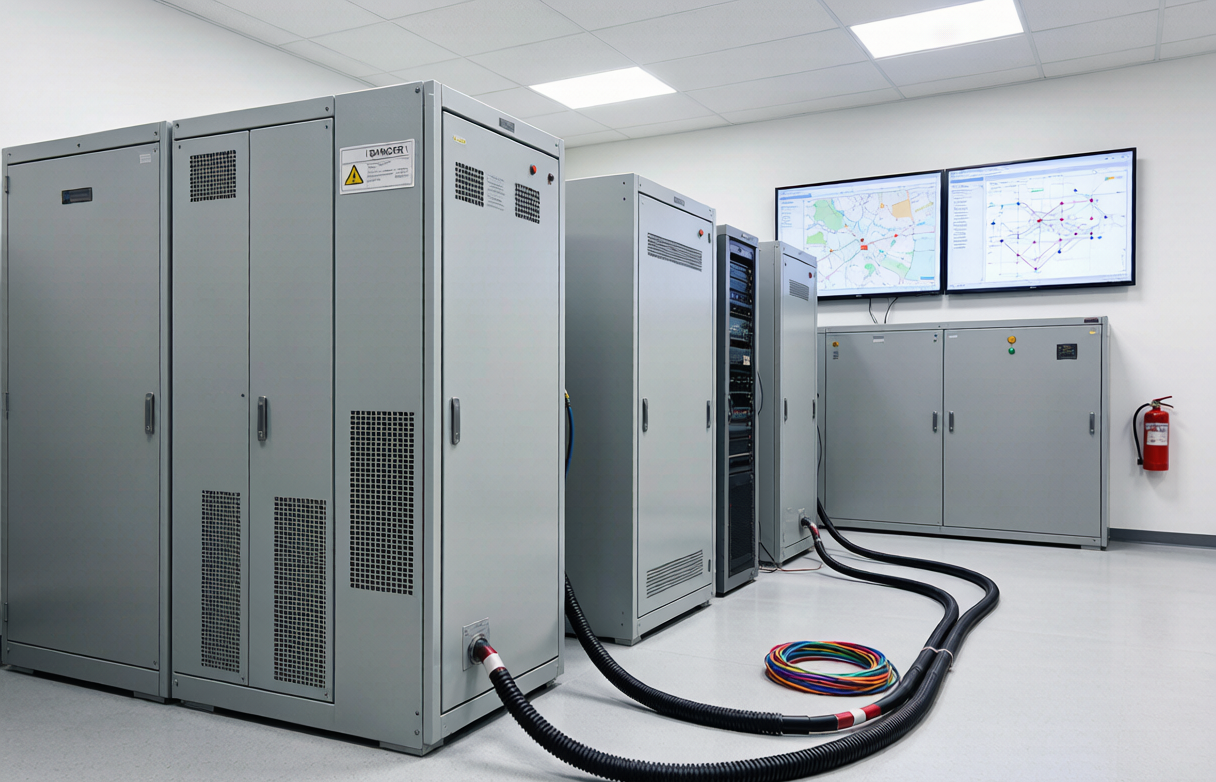
Energy & Power Dispatch Storage Needs & Stonbel's Role
The reliability of energy and power dispatch systems begins with the stable operation of every embedded storage chip. Grid dispatch centers must aggregate real-time operational data from substations and renewable energy stations across the province, performing AI load forecasting and fault prediction. In this scenario, data acquisition terminals, edge inference nodes, and dispatch hosts are often deployed outdoors or in high-temperature server rooms with severe temperature fluctuations. Ordinary consumer-grade storage chips are

Core Product Data
In energy and power dispatch scenarios, data acquisition terminals, edge inference nodes, and dispatch hosts often face extreme temperature conditions. Stonbel's eMMC_UFS embedded storage modules cover two mainstream types: eMMC (8GB to 128GB, compliant with eMMC 5.1/JESD84, sequential read/write speeds up to 320/260 MB/s, operating temperature -40~85℃) and UFS (64GB to 256GB, compliant with UFS 2.1/3.1/JESD220, sequential read/write speeds up to 4300 MB/s, operating temperature -40~105℃). Additionally, for different host platforms, Stonbel offers industrial wide-temperature eMMC (8GB~256GB) and UFS (16GB~256GB) options,

Deployment Results
In a provincial grid dispatch center upgrade project, Stonbel's eMMC_UFS embedded storage solution, combined with edge inference nodes and dispatch displays, achieved millisecond-level response for data acquisition, storage, and visualization across the province's substations. eMMC 5.1 modules ensured stable startup at -40℃, preventing data loss from outdoor monitoring equipment in winter; UFS 3.1 modules sustained 4300 MB/s read/write bandwidth in high-temperature server rooms,
Customer Value
For system integrators and end users in the energy and power industry, choosing Stonbel as the source manufacturer for eMMC_UFS embedded storage reduces project preparation time by over 30%. Customers avoid extensive hardware selection and compatibility testing, as Stonbel's factory-direct industrial wide-temperature storage modules are certified with 3C, CE, FCC, ROHS, and comply with ISO9001 and ISO14001 management systems. For classified and high-reliability scenarios, Stonbel holds military and classified project qualifications, offering localized on-site services with service points across 31 provinces, ensuring timely fault response and
Roadmap
Looking ahead, Stonbel plans to expand its eMMC_UFS embedded storage product line for energy and power dispatch, evolving from current eMMC 5.1 and UFS 2.1/3.1 standards toward next-generation embedded storage with higher bandwidth and larger capacity. Combined with intelligent data tiering and cold/hot archiving, hot data in dispatch centers will reside on high-speed UFS modules, warm data migrated to SSDs, and cold data archived to cost-effective media, reducing overall
Q1: Why do energy and power dispatch scenarios require industrial wide-temperature eMMC_UFS embedded storage?
A: Outdoor monitoring terminals and edge nodes in grid dispatch centers often operate in extreme temperatures ranging from -40℃ to 85℃ or even 105℃. Consumer-grade storage chips are prone to read/write errors or startup failures under such conditions. Stonbel's eMMC_UFS embedded storage modules operate across -40~85℃ (UFS up to -40~105℃), compliant with eMMC 5.1 and UFS 2.1/3.1 industrial standards, ensuring stable operation in freezing or high-temperature environments and preventing data loss during real-time dispatch data logging.
Q2: Which is more suitable for grid dispatch centers: eMMC or UFS embedded storage?
A: It depends on the specific node requirements. eMMC 5.1 offers sequential read/write speeds of 320/260 MB/s, with lower cost and mature ecosystem, suitable for mid-to-low-end embedded controllers such as substation data acquisition terminals. UFS 2.1/3.1 provides significantly higher serial bandwidth, with sequential read/write speeds up to 4300 MB/s, ideal for high-performance edge inference nodes and dispatch hosts requiring rapid access to historical data for AI load forecasting models. Stonbel offers industrial wide-temperature options from 8GB to 256GB, supporting both eMMC and UFS standards, ensuring customers receive cost-effective solutions for different scenarios.
Q3: What qualifications does Stonbel have as a source manufacturer for energy and power dispatch storage projects?
A: Stonbel holds 3C, CE, FCC, ROHS, ISO14001, and ISO9001 certifications, as well as military and classified project qualifications, meeting the stringent security and compliance requirements of the energy and power industry. Our service network covers 31 provinces with on-site service points and 7×24-hour operations support. In past projects, we provided classified meeting display and storage solutions for the China Electronics Technology Group Corporation's Electronic Science Research Institute, passing classified site security acceptance with zero data leakage.
Q4: How to evaluate the delivery capabilities of an eMMC_UFS embedded storage manufacturer for energy and power dispatch?
A: Focus on three key aspects: First, whether the product line covers both eMMC and UFS standards with comprehensive capacity and temperature ranges—Stonbel offers 8GB~256GB eMMC and 16GB~256GB UFS industrial wide-temperature models. Second, whether the manufacturer provides factory-direct supply and full-process support—as a source manufacturer, Stonbel reduces project preparation time by over 30%. Third, whether there are proven case studies—such as the provincial government cloud disaster recovery center project achieving RPO near zero and RTO under 15 minutes, validating large-scale data storage and disaster recovery
Reliable embedded storage infrastructure is essential for energy power dispatching systems. Stonbel, as a source manufacturer, provides industrial wide-temperature eMMC_UFS modules covering -40 to 105°C, along with dispatch displays, edge inference nodes, and cloud-edge collaboration, forming a full-chain closed loop from data ingestion to display. With 3C, CE, FCC, military, and classified certifications, plus a service network across 31 provinces, Stonbel has served Huawei, Peking University, Peking Union Medical College Hospital, and Guangdong Emergency Management Department, ensuring high-reliability, compliant computing infrastructure for government and enterprise energy projects. Stonbel will continue to advance energy dispatching scenarios, helping grid centers achieve the leap from passive response to proactive prediction.